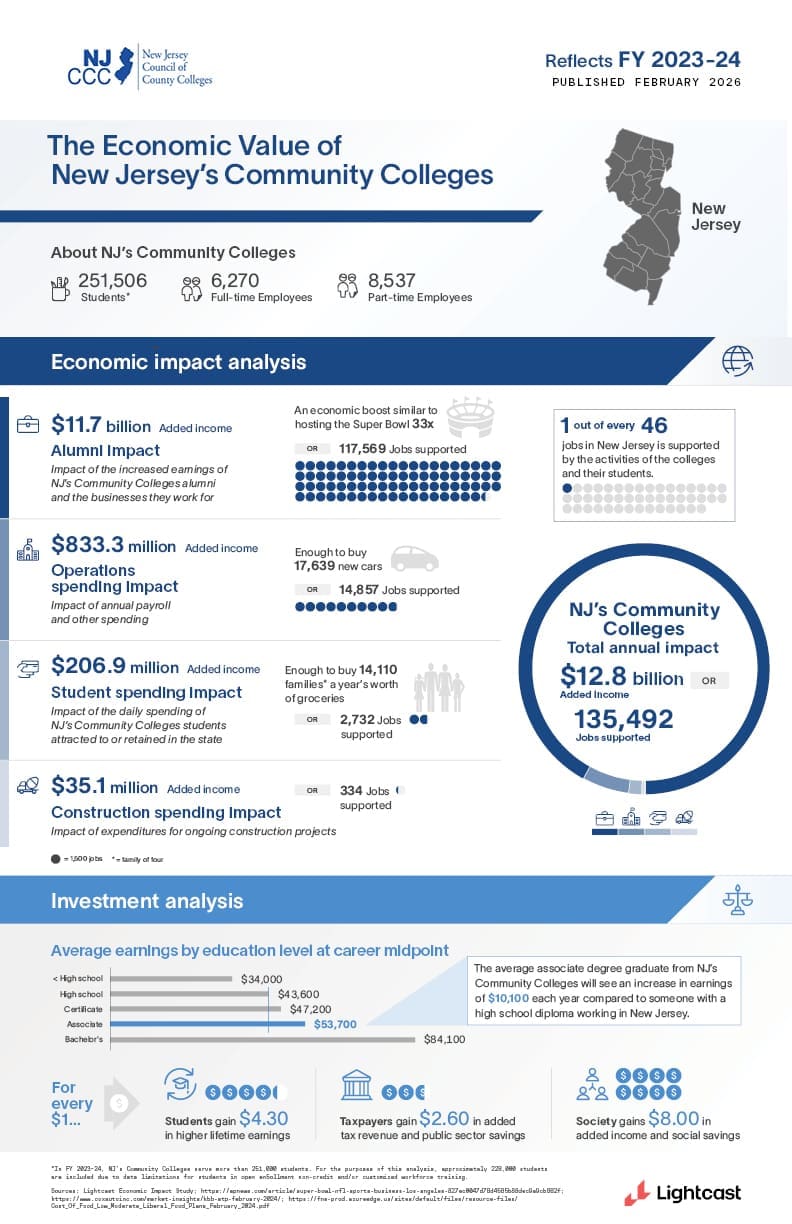
Community colleges power the economy: The profound impact on jobs supported by the activities of New Jersey community colleges and their more than 250,000 students goes beyond the direct employment of faculty and staff at the colleges of 14,807 full- and part-time employees. Spending of New Jersey community colleges and their students, as well as the activities of their alumni, contribute to 135,492 jobs in the state including 20,535 jobs in Health Care and Social Assistance, 15,589 jobs in Retail Trade, 13,397 jobs in Real Estate & Rental & Leasing, 9,535 jobs in Professional & Technical Services; and 7,324 jobs in Government, Non-Education.
Investing in New Jersey community colleges brings significant ROI for taxpayers and society: For every dollar invested in a New Jersey community college by the state and counties, taxpayers gain $2.60 in added tax revenue and public sector savings.
The study also found that for every dollar invested in a New Jersey community college, society overall gains $8.00 in added income from students’ increased lifetime earnings and increased business output, raising economic prosperity in the state. Benefits to society also include the savings generated by improved lifestyles of community colleges’ students—which include such factors as reduced unemployment and welfare claims, an savings from better health outcomes.
Community colleges provide a strong return on students’ investment by offering an affordable path to a high-quality postsecondary education, and expand opportunities for students to earn a bachelor’s degree: The study provides strong evidence that community colleges provide significant returns to students, offering an affordable path to a postsecondary education. Students who attend community college experience significant savings in the cost of education, removing financial barriers for students who would not otherwise be able to afford college and saving taxpayers money by reducing state financial aid expenditures. Community college students gain $4.30 in higher lifetime earnings for every $1 they spend, driven by higher lifetime earnings. This is an average annual return of 14.9% for students.
Community college students who attend college full-time save an average of $16,000 per year on tuition and fees than had they attended a four-year college or university in the state.
Community colleges also expand opportunities for students to earn a bachelor’s degree who may not have attended college otherwise. While the economic impact study does not account for the students who go on to receive a Bachelor’s degree, nearly 1 in 5 students who earn a Bachelor’s degree at a public four-year college and university in New Jersey started their postsecondary education at a community college.
The Economic Value of New Jersey’s Community Colleges was completed by Lightcast, a nationally recognized economic and data consulting company with deep expertise in labor market, workforce, and higher education impact analysis. Data and assumptions used in the study are based on FY 2023-24 academic and financial reports from the colleges; industry and employment data from the U.S. Bureau of Labor Statistics and the U.S. Census Bureau, Lightcast’s modeling, and studies and surveys relating education to social behavior.