New Study Quantifies “Substantial Economic Impact” of New Jersey’s Community Colleges
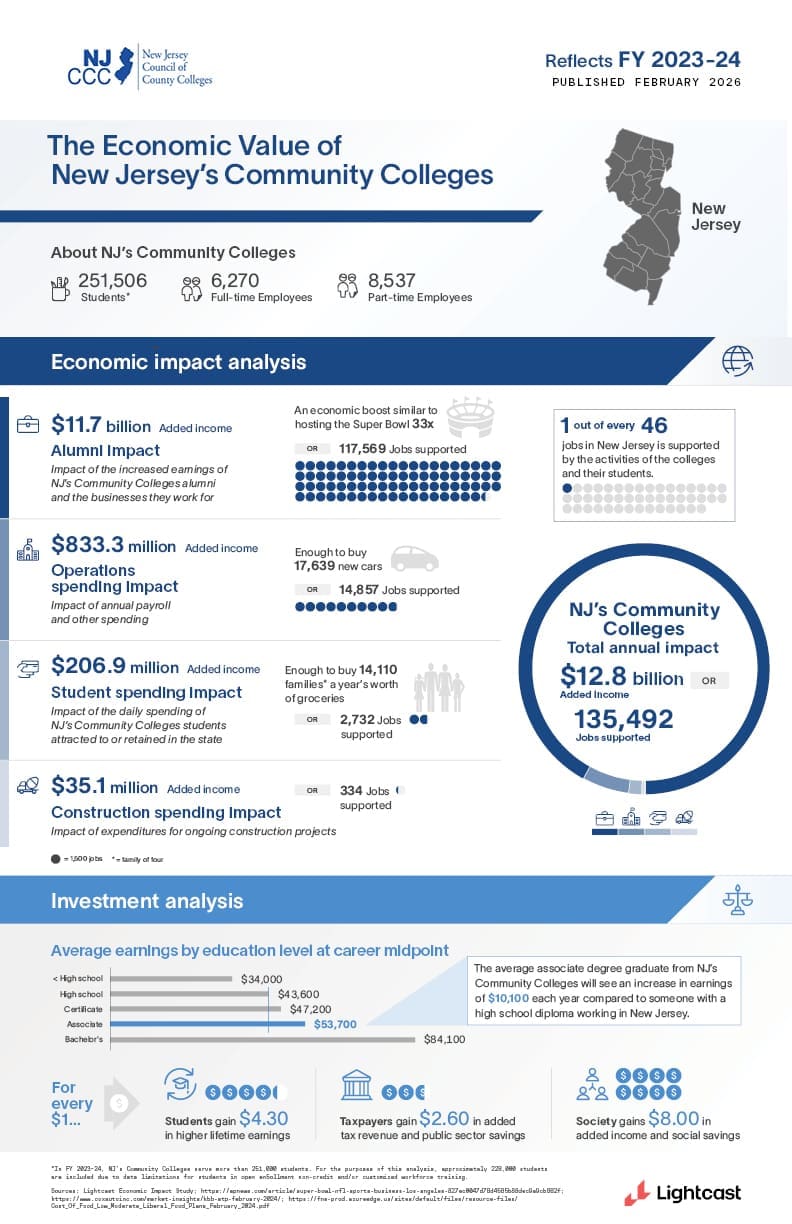
New Jersey’s 18 Community Colleges lead to increased earnings of graduates and contribute $12.8 billion annually to the state’s economy, supporting more than 135,000 jobs
Hamilton, NJ February 26, 2026 – According to a new independent economic impact analysis, New Jersey’s 18 community colleges add $12.8 billion to the state’s economy annually—a value roughly equal to 1.6 percent of the total gross state product.
This added income supports 135,492 New Jersey jobs: in other words, the activities of New Jersey community colleges, their students, and their graduates support one out of every 46 jobs in the New Jersey labor market.
“This analysis quantifies and reinforces what we already knew about the substantial economic impact of New Jersey’s 18 community colleges,” said Aaron Fichtner, President of the New Jersey Council of County Colleges (NJCCC).
The $12.8 billion in added income generated by New Jersey’s community colleges includes:
• $11.7 billion in alumni impact—resulting from the earnings boost of more than $10,000 for an Associate degree holder compared to a high school graduate;
• $833.3 million in the form of operations spending including payroll and facilities maintenance;
• $35.1 million for new construction spending; and
• $206.9 million of spending by New Jersey community college students.
Fichtner continued: “Community college alumni, through their knowledge, creativity, and entrepreneurship, meet the workforce needs of the state’s evolving innovation economy and, through higher lifetime earnings, contribute directly to our state’s economic prosperity.”
The study—The Economic Value of New Jersey’s Community Colleges—also found that investing in New Jersey community colleges brings significant return on investment for taxpayers and society: For every dollar invested in a New Jersey community college by the state and counties, taxpayers gain $2.60 in added tax revenue and public sector savings. Further, for every dollar invested in a New Jersey community college, society overall gains $8.00 in added income from students’ increased lifetime earnings and increased business output, raising economic prosperity in the state. Benefits to society also include the savings generated by improved quality of life of community colleges’ graduates—which include such factors as reduced unemployment, reduced reliance of social services, and better health outcomes.
At a time when the public at large has questioned the value of higher education, this analysis found that for every $1 students invest to attend a New Jersey community college, they gain $4.30 in higher lifetime earnings. Put another way, New Jersey community college students enjoyed an average rate of return on their college investment of 14.9 percent—4 percent higher than the 10.9 percent stock market average annual rate of return.
“Our community colleges open doors of economic opportunity for New Jerseyans across the state, including many who are low-income, first generation, and from backgrounds traditionally underrepresented in higher education,” said Jessica Stewart Purnell, NJCCC’s Chair and trustee at Camden County College.
The study provides strong evidence that community colleges provide significant returns to students, offering an affordable path to a postsecondary education. Students who attend community college experience significant savings in the cost of education, removing financial barriers for students who would not otherwise be able to afford college and saving taxpayers money by reducing state financial aid expenditures. Full-time New Jersey community college students save an average of $16,000 per year on tuition and fees than if they had attended a four-year college or university in the state.
Community colleges also expand opportunities for students to earn a bachelor’s degree who may not have attended college otherwise. While the economic impact study does not account for the students who go on to receive a Bachelor’s degree, nearly 1 in 5 students who earn a Bachelor’s degree at a public four-year college and university in New Jersey started their postsecondary education at a community college.
“As this study indicates, every dollar we invest in New Jersey’s community colleges pays dividends to our students, our employers, our communities, and our state. We look forward to working with the new Sherrill Administration and our State Legislators to expand access to affordable, high quality education at our state’s 18 community colleges,” said Maria Heidkamp, NJCCC’s Chief Innovation and Policy Officer.
The Economic Value of New Jersey’s Community Colleges was completed by Lightcast, a nationally recognized economic and data consulting company with deep expertise in labor market, workforce, and higher education impact analysis. Data and assumptions used in the study are based on FY 2023-24 academic and financial reports from the colleges; industry and employment data from the U.S. Bureau of Labor Statistics and the U.S. Census Bureau, Lightcast’s modeling, and studies and surveys relating education to social behavior.
Downloadable Resources
Economic Impact Study Executive Summary
Economic Impact Study Infographic
Economic Impact Study Main Report
Economic Impact Study Fact Sheet